
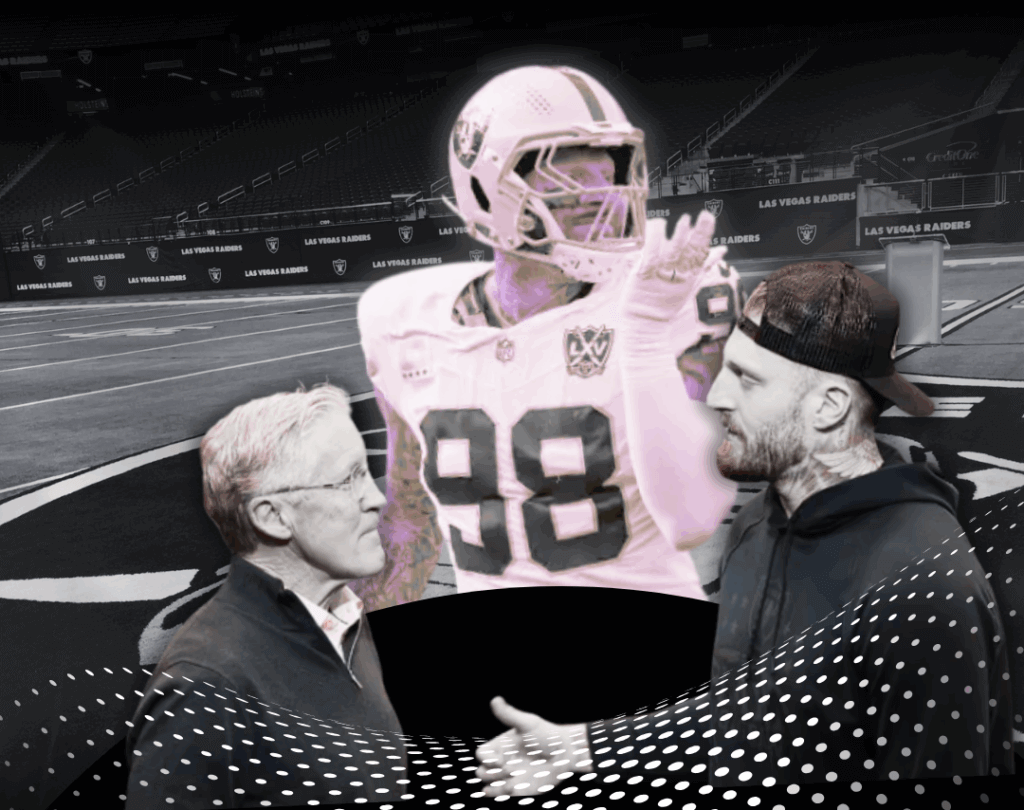
Maxx Crosby’s frustration has intensified questions about his future with the Las Vegas Raiders. Well, at least in the eyes of fans and media observers. Let’s preface this by stating the obvious: no one knows what the organization has planned now.
Still, it is fair to ask whether the Raiders’ relationship with their franchise star has hit a breaking point—or if there is still time to repair it.
Should the Raiders consider trading away Maxx Crosby?
Crosby has played through more pain than most players would tolerate, and the Raiders finally decided they had seen enough. After nine weeks spent dragging a damaged knee through blowouts and empty Sundays, the franchise informed its star edge rusher he was being shut down.
Crosby’s reaction was predictable: he vehemently disagreed and left the building. The fallout was instantaneous. Trade speculation exploded, and the discussion has quickly shifted from short-term frustration to long-term viability. The question is, though, has the relationship completely fallen off between the Raiders and their star pass rusher?
This is the collision point between elite competitiveness and organizational self-preservation. Raider Nation and analysts split immediately. Some argued Crosby deserved better from a franchise that has offered little stability. Others said the Raiders had no choice but to protect their best player from himself. And many skipped straight to hypotheticals, sketching trade packages, cap maneuvers and imagined reunions with defensive-minded coaches elsewhere.
Are things salvageable?
The noise grew louder when national insiders amplified the story. Jay Glazer reported that Crosby “vehemently disagreed” with the shutdown. Multiple analysts called the contract “extremely tradable.” Social media, always eager for chaos, supplied its own geography lesson, mapping Crosby to Chicago, New York, Baltimore or anywhere the Raiders are not.
Crosby did his part to keep the fire burning. Asked earlier in the week about the No. 1 pick being on the line, he brushed off the premise entirely. “I don’t give a sh*t about the pick,” he said. “My job is to be the best defensive end in the world.” That is not the voice of a player ready to sit for strategic purposes. It is the voice of someone who has built a career refusing to accept losing as inevitable.
Raiders head coach Pete Carroll tried to downplay the tension, framing Crosby’s reaction as the natural response of a fierce competitor. Carroll’s explanation sounded sympathetic and even deferential, but it did not change the core reality: the Raiders believe shutting Crosby down is in the organization’s best interest. Crosby believes pushing through is in him.
When those priorities diverge, fractures form. Right now, those fractures are widening in public.
The Raiders can insist that all of this is temporary discomfort. Crosby can insist he is simply wired to compete. But the question the league is already asking—and the one the Raiders can no longer ignore—is whether this moment marks a turning point. A franchise cornerstone wants to play. A franchise in transition wants him preserved.
At some point, those timelines must reconcile. Or they will separate.
*Top Photo: Ramble Illustration/Getty Images