
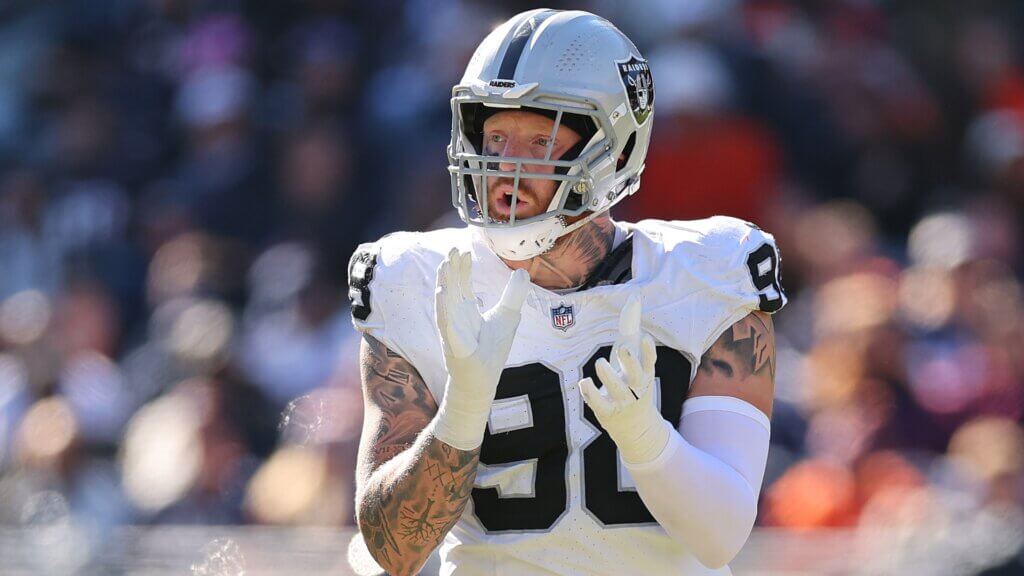
In a season where the Las Vegas Raiders have generated a paltry pass rush, getting perennial Pro Bowler Maxx Crosby some help should be the top priority. The question is, do you use a Day 1 or 2 pick to do so?
Look, there’s no easy way to say it but the experiment of Pete Carroll running the defense (with Patrick Graham retaining the title of defensive coordinator) failed miserably. The gap between Crosby and the rest of the so-called pass rushers on the Raiders is immense. No. 98 will once again lead the team in sacks when the season concludes—he currently has nine tallied. Below, in second place, we have Jonah Laulu. Malcolm Koonce and Tyree Wilson combined have five—that’s just not going to do much to move the needle.
Assuming that both Carroll and Graham are gone in the offseason, replenishing and rebuilding the defense will be just as important as addressing the quarterback position. However, what if there’s a way to help begin laying a foundation on both sides of the ball? Don’t fret, Raider Nation—we have you covered.
Round 1: Rueben Bain Jr., EDGE, Miami
Rueben Bain Jr. is the kind of prospect who forces evaluators—and franchises like the Raiders—to confront an uncomfortable truth about the modern NFL draft: traits are currency, but substance still wins games.
At first glance, Bain does not look like a prototype savior for a rebuilding defense. His arms are short. His testing will not rewrite NFL combine history. He’s unlikely to post the sort of eye-popping measurables that dominate draft-night graphics. In an era obsessed with ceilings, that matters. It is also precisely why Bain could make sense for team brass.
What Bain brings instead is density, leverage and violence—three qualities the Raiders’ defensive front has repeatedly lacked when it matters most. He plays with a compact, muscular frame that naturally creates a low pad level, allowing him to anchor against the run and collapse pockets through sheer force. He does not guess nor does he freelance. Bain sets edges, holds gaps and makes offensive linemen earn every inch. That discipline alone would make him an immediate upgrade for a team that has struggled to get off the field on early downs.
As a pass rusher, Bain wins in ways that translate. His speed-to-power is real, not theoretical. He can threaten the edge from wide alignments, then drive tackles backward with leverage and balance. He is not a rare straight-line athlete, but his fluidity and flexibility for his size allow him to bend and finish without losing momentum—a combination more valuable than highlight-reel burst.
Why should the Raiders draft Bain?
What stands out most is his growth curve. Bain is not just a power rusher. He flashes legitimate technique with swipes, clubs, and counters and understands sequencing rather than leaning on a single move. There is room to expand his arsenal, particularly with leverage-based techniques like a forklift or hump move, but the foundation is clear. He knows how to rush.
Some critics will point to history. Top-five edge defenders usually come with elite measurables or jaw-dropping traits. Bain does not fit neatly into that box. That is fair. It is also incomplete.
For the Raiders, this is the actual question: Do they want theoretical upside, or do they want a three-down defender who plays with grown-man strength, discipline and urgency from Day 1? For a franchise desperate for defensive credibility, that may matter more than chasing perfection.
Round 2: Ty Simpson, QB, Alabama
Ty Simpson is the uncomfortable evaluation—the kind that exposes whether an NFL franchise actually understands how quarterbacking works in 2025. For the Raiders, we don’t even know if they can properly scout the position. Who’s going to make the decision? Will it be John Spytek, Tom Brady, or someone else?
For three seasons at Alabama, Simpson waited. He backed up Bryce Young. He backed up Jalen Milroe. There were flashes—a 79-yard touchdown run here, a comeback spark there—but nothing resembling momentum. Then Kalen DeBoer and Ryan Grubb took over, watched one spring practice, and handed him the offense without hesitation.
Five games into 2025, that decision looks prophetic.
Why should the Raiders draft Simpson?
What separates Simpson is not arm strength or athletic theater—it’s his command. Pre-snap, he diagnoses coverages with motion, resets protections, and identifies pressure like a veteran. Post-snap, his eyes manipulate safeties, opening windows that should not exist. His release is quick enough to neutralize pressure before it forms, and his ball placement consistently turns routine completions into yards after catch. Receivers do not adjust to Simpson’s throws. They run through them.
His pocket presence is surgical. He climbs when needed, slides when appropriate, escapes without panic, and never looks rushed. The internal clock is already calibrated. His processing speed allows him to reach third reads before pressure arrives, and his decision-making reflects a rare balance of aggression and restraint.
For the Raiders, this is where the conversation gets uncomfortable. Simpson does not win the combine. He wins football games. His projection is not theoretical. He is already operating an NFL-style offense with NFL-level answers. His floor is a capable starter who wins with timing, intelligence and efficiency. His ceiling reaches far higher.
The modern NFL keeps delivering the same message: quarterbacks win with their minds. Processing speed, anticipation and accuracy age better than raw traits. Ty Simpson is that evolution in real time.
*Top Photo: Getty Images