
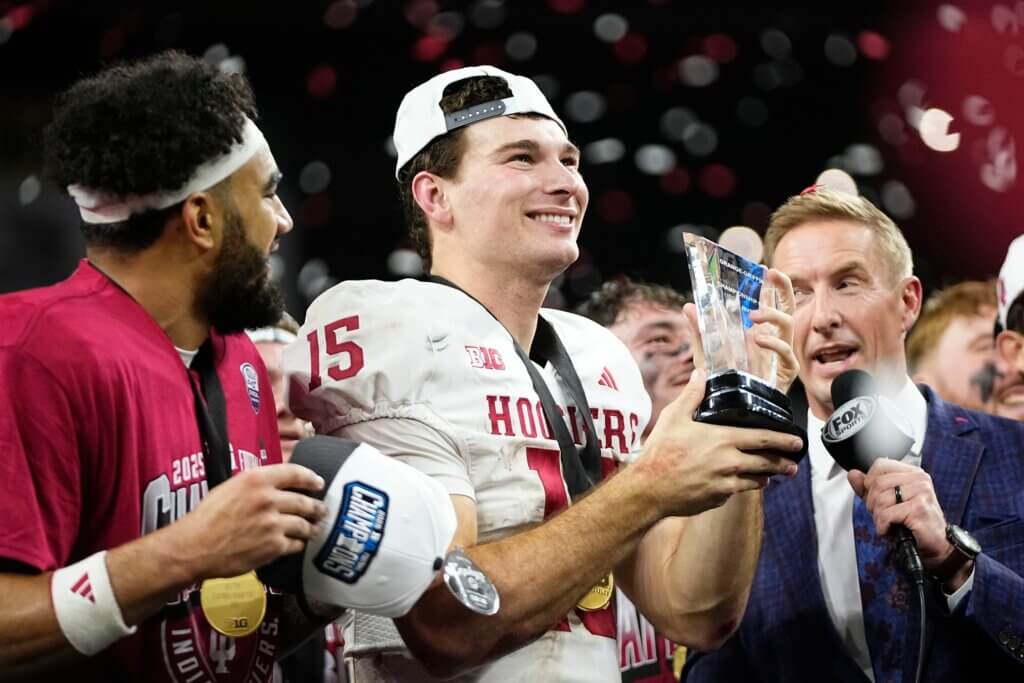
The Las Vegas Raiders don’t need to spend premium money on a veteran “bridge” quarterback to protect Fernando Mendoza. They need to protect him with something real: a functional offensive line.
As the NFL offseason ramps up in late February 2026, the Raiders are at a crossroads that could shape the next decade of Silver and Black football. Holding the No. 1 overall pick in the 2026 NFL Draft, the franchise is positioned to select the Indiana quarterback, who’s widely viewed as the top prospect after a decorated college run.
At 6-foot-5 and 225 pounds, Mendoza fits the profile general manager John Spytek and the new regime have described in a franchise quarterback: size, arm talent, composure under pressure and the leadership to guide a locker room through inevitable growing pains.
Still, whispers persist in Raider Nation and media circles about signing an expensive veteran quarterback as a “bridge” to ease Mendoza’s transition. That approach runs counter to the rebuild the Raiders have embraced under coach Klint Kubiak, Spytek and a front office focused on long-term roster construction.
Las Vegas should avoid tying up significant cap space in a high-priced stopgap and instead direct its resources toward building a sturdier foundation—reinforcing both lines, upgrading the defense, and improving the supporting cast Mendoza will actually need to develop. Expectations for 2026 should be measured. Chasing short-term relevance with an expensive bridge risks wasting premium resources and testing the patience required for a real rebuild.
Start up front. Mendoza thrived when protected in college, but NFL fronts are faster and the margin is thinner. The Raiders’ line struggled in 2025, and a $25 million to $35 million bridge QB would still need protection—while eating the money needed to sign and develop real linemen.
Mock Draft: Rebuilding the trenches for Klint Kubiak’s offense
What do the Raiders do with all of their cap space?
With nearly $100 million in cap space, the Raiders have a rare chance to address multiple starting-caliber needs across the offensive line. Investing in athletic guards and tackles who fit Kubiak’s wide-zone vision should be a priority. A bridge quarterback does nothing to block for Mendoza; improved trench play does. Rookie quarterbacks asked to operate behind shaky protection often struggle to find rhythm and confidence, even when the talent is obvious. Teams that built sturdier fronts around young passers have seen faster growth, while thin protection tends to recreate the same problems year after year.
That logic applies to the defense, too. A weak run defense and inconsistent pass rush have hurt the Raiders. Mendoza needs close games, not early deficits that force hero ball. Stronger interior tackles and real edge pressure would support a rookie quarterback.
Kubiak also indicated at the NFL scouting combine that, under defensive coordinator Rob Leonard, the Raiders are preparing for a transition to a 3-4 base defense after operating out of a 4-3 look. That kind of shift raises the stakes on personnel decisions. It requires a nose tackle who can anchor, edge defenders who can set the edge and rush, and linebackers who can fit the run and hold up in coverage. With that level of defensive recalibration underway, diverting major cap resources to an expensive veteran quarterback would be a poor allocation, leaving critical needs in the new structure unaddressed during a pivotal year.
Navigating NFL free agency…
Free agency can help the Raiders add starters at defensive tackle, edge rusher, linebacker and cornerback without wrecking the cap. But every dollar spent on a veteran signal-caller is money not spent on pass rush or coverage. The Raiders were near the bottom last year in sacks, yards allowed, takeaways and red-zone defense. A bridge QB won’t fix that. A stronger front seven and secondary will—and it buys time for the offense to grow.
Expectations for 2026 also should be realistic, and that is fine. The Raiders are not one player away from contention. They are in the foundational stage of a multi-year reset. Mendoza may be advanced in terms of scheme fit and toughness, but he is still a rookie, and even polished first-round quarterbacks need time to adjust to NFL speed, weekly game planning and the demands of running an offense.
Adding a high-priced veteran risks muddying the message. It can split reps, create an awkward quarterback room dynamic and raise win-now expectations that do not match the roster’s current state. Raiders fans have seen similar “bridge” plans before, and too often they extend mediocrity instead of accelerating progress.
Measured expectations let the Raiders develop Mendoza on purpose. If the line is ready, play him. If not, stay patient and lean on a low-cost option like Aidan O’Connell. The goal is long-term stability, not a hollow 7-10 push that wastes cap space and picks.
Related: There’s one man pulling the strings in Sin City now
There’s no need for a “bridge” if you’re the Raiders…
That brings the discussion back to financial reality. Adding a high-priced veteran quarterback would cannibalize the very resources the Raiders need to address more urgent weaknesses. With more than $100 million in cap space, Las Vegas can realistically pursue multiple impact starters—interior offensive linemen, a true cover corner, linebacker help and quality depth across the roster. A top-of-market quarterback contract could consume roughly a quarter of that space before the Raiders fill a single hole elsewhere.
The front office has signaled a data-driven, value-oriented approach. Spytek has consistently emphasized traits over name value and building through the trenches. Pivoting now to chase a splashy veteran would run against the process that put the Raiders in position to reset the roster and draft at the top. Cap flexibility is a rare advantage for a rebuilding team. Spending it on a bridge quarterback would limit the rest of the plan when too many foundational needs remain.
Above all, Raider Nation has to embrace patience. This is a rebuild, not a retool. The franchise has cycled through quarterbacks, coaching staffs and short-term fixes for years, often choosing splash over substance. The current regime—a new head coach, a second-year general manager, a new defensive coordinator and a clear mandate to take the best quarterback available at No. 1—represents a chance to build with purpose instead of patching cracks.
Patience does not mean apathy. It means understanding how sustainable success is built in the NFL: in the trenches, with complementary roster pieces, and with time for a young quarterback to develop. The Raiders have 10 draft picks, significant cap room and a prospect who looks like a franchise centerpiece. Forcing the timeline with an expensive bridge would undermine their biggest advantages.
More: There’s finally real hope for Raider Nation in 2026
Raider Nation has something to be excited about…
Fans have every reason to be excited about Mendoza’s arrival. His arm talent, leadership and championship résumé are real. That excitement, though, has to be paired with realistic expectations and real support—celebrating the draft-day selection, backing a trench-focused plan in free agency, and accepting that 2026 may be uneven while the foundation takes shape. Social media outrage cycles and talk-radio demands for instant results have helped sink previous regimes. This time has to be different.
If Spytek is serious about the quarterback traits he has outlined, Mendoza fits them. If Kubiak’s offense is the direction, it will require a clean pocket, a reliable run game, and play-action efficiency. And if the Raiders are going to stabilize a young quarterback, the defense has to hold up, stop the run and create pressure so games stay manageable.
The alternative is familiar. Signing an expensive veteran bridge would drain resources from the offensive and defensive lines, weaken the roster during a defensive scheme transition, and inflate expectations a rebuild is not built to meet. It would be another short-term fix that extends the same cycle the franchise says it is ready to end.
The path is clear: draft Mendoza at No. 1, strengthen both lines with smart free-agent and draft investments, and accept that 2026—and possibly 2027—will involve development as much as results. The payoff comes to teams willing to endure short-term discomfort for long-term stability.
*Top Photo: Getty Images