
A major trade with the Los Angeles Rams alters this Las Vegas Raiders 7-round mock draft, changing Las Vegas’ draft board and roster-building strategy with new selections, valuable targets, and a clear plan for the offseason following the combine.
General manager John Spytek enters this year’s draft with two storylines that shape everything. The first one feels settled. With the No. 1 pick, Indiana quarterback Fernando Mendoza gives the Raiders a franchise piece to build around.
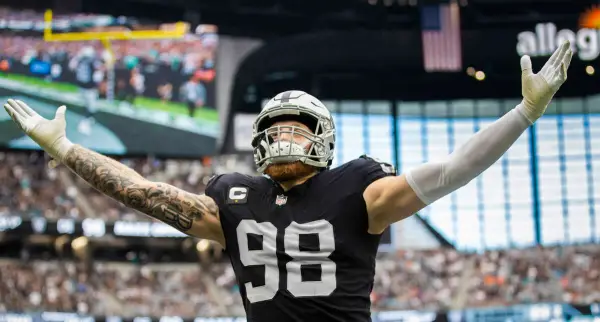
The second one is more complicated. Maxx Crosby’s future dominated combine week for a reason. Elite edge rushers change games, and Crosby is the kind of player who can push a good team over the top.
For this scenario, that team is the Rams. They need a jolt to get back to the Super Bowl, and Crosby would give them exactly that. The real question is whether Spytek would be willing to move a cornerstone player, and one of the most popular Raiders in the building, to speed up the rebuild around Mendoza.
Raiders fans will have strong feelings about it, and that is understandable. Crosby is the heartbeat of the defense. But this is the kind of decision front offices have to weigh when they are trying to build something that lasts.
Here is how a deal like this could look.
Raiders 7-Round Mock Draft: A Maxx Crosby trade that changes everything…
- Raiders receive: No. 13 pick, ’27 1st round pick, NT Poona Ford
- Rams receive: EDGE Maxx Crosby
Round 1, No. 1: Fernando Mendoza, QB, Indiana
Fernando Mendoza isn’t the kind of quarterback who grew up with a spotlight. He had to earn one. A three-star recruit who was once headed to Yale, he kept betting on himself, jumped to a bigger stage, and kept climbing. The résumé isn’t perfect. The wins weren’t there, and the interceptions showed up. But the reason evaluators keep coming back is simple: he looks like an NFL quarterback.
He’s big enough and athletic enough, and he can really throw it. Most of all, he’s accurate in the middle of the field, fitting passes into tight windows and turning back-shoulder shots into routine plays. If the Raiders draft him, it’s not a fairy tale. It’s a calculated swing.
Round 1, No. 13: Akheem Mesidor, EDGE, Miami (FL)
Akheem Mesidor feels like the kind of edge rusher coaches fall for because the effort is obvious and the plan makes sense. He can win with speed, but he doesn’t rely on it. When tackles overset, he counters inside. When he gets reduced, he can bother guards, too. He keeps working mid-rush instead of dying on first contact, and he plays the run with real urgency.
There are reasons he might slide: he’s older, he’s not as long as most edge setters, his anchor is only OK, and the injury history will scare teams. For the Raiders, that could be the value.
Round 2, No. 36: Blake Miller, OT, Clemson
This is the kind of lineman the Raiders have to get right if they’re serious about protecting their next quarterback. The best part is clear: Blake Miller can pass block. He keeps the pocket clean, handles different types of rushers, and he’s shown he can play either tackle spot without looking rattled. That matters.
The run game is where the warts show up. He can play too tall, his hands get wide, and his balance goes when defenders counter back into him. In space, the feet can get messy. If the Raiders draft him, it’s a simple bet: protect first, coach up the rest.
Round 3, No. 67: Gracen Halton, DL, Oklahoma
Gracen Halton is the kind of defensive tackle you draft because you can see what he could be. He’s quick for an interior guy, athletic enough to loop on stunts, and he can win as a pass rusher with a swim move and a nonstop motor. When the pocket gets messy, he keeps coming.
The concern is that he’s giving away too many easy yards right now. He’s shorter with shorter arms, he’ll take a false step, and he can be late reading reach blocks and get washed out. He also plays high with a narrow base, so double teams move him. If the Raiders take him, it has to be with patience and coaching.
Round 4, No. 102: Genesis Smith, DB, Arizona
This feels like the kind of defensive back coaches trust because he just does his job. Genesis Smith played a lot for three straight years, helped on special teams early, and kept getting better until he left school with an All-Big Ten mention. On tape, he’s smooth and under control. He transitions cleanly, has enough speed to close, and reads the quarterback well in zone so he can rotate and take away windows. He also shows up in the run game, staying disciplined and working around blocks.
The big question is upside. Is he a playmaker or more of a steady, mistake-free starter? If the Raiders draft him, they’re probably betting on reliability—and letting the splash plays come later.
Round 4, No. 117: Malik Muhammad, CB, Texas
Malik Muhammad is the kind of corner teams chase because he can play real man coverage. He has quick feet, stays in phase, and can stop and start without losing balance. The speed shows up when he turns and runs, and he does not need a safety holding his hand on every rep. He also tackles with intent and plays downhill, which matters when your division is full of perimeter weapons.
If the Raiders draft him, the idea is simple: make quarterbacks hesitate. Coverage forces longer reads, longer reads create sacks, and sacks create turnovers. That is how a defense changes fast.
Round 4, No. 134: Le’Veon Moss, RB, Texas A&M
Le’Veon Moss is the kind of back who makes defenses pay for being a half-step late. The speed is real, and once he hits the second level, pursuit angles start to disappear. He’s not just fast, though. He runs angry, breaks first contact, falls forward, and keeps turning four-yard plays into eight and eight-yard plays into 15 with a nasty stiff arm. In tight spaces, he’s quick and decisive, and he looks like a guy you trust on third-and-1.
If the Raiders draft him, the debate is simple: is this the time to spend a pick on a runner, or can you find this value later?
Round 5, No. 174: Jaeden Roberts, OG, Alabama
This is the kind of prospect you draft because the body and power are hard to find. Jaeden Roberts has rare strength and long arms, and when he lands his hands, you see blockers get stopped in their tracks. He can also handle heavy contact, fight through doubles, and close off lanes in the run game.
The concern is that it does not always work together. He can look stiff, his footwork gets messy, and when blockers move across his face, he is often late to adjust. The drop from 2024 to 2025 matters, too. If the Raiders take him, it should be with a defined role and patient coaching, not immediate expectations.
Round 6, No. 181: Bishop Fitzgerald, DB, USC
Bishop Fitzgerald is a turnover business model. The ball production is consistent across stops, and his quarterback background shows in how he baits throws. The speed is functional, and his zone range changes play calls. The questions are size, run support, and medicals. If the Raiders draft him, it is a bet on takeaways over traits.
Round 6, No. 184: Red Murdock, LB, Buffalo
Murdock is a specialist with a headline skill: forced fumbles. Everything else is replacement level. He plays lighter than advertised, loses contact balance, and lacks burst, range and coverage value. When kept clean or blitzed, he functions. In space, he does not. If the Raiders draft him, it should be late and role-specific: special teams, pressure packages, and turnover hunting.
Round 7, No. 219: Roman Hemby, RB, Indiana
Roman Hemby feels like a steady, trustworthy back who keeps an offense on schedule. He sees the lane, makes one cut, and gets downhill with purpose. He runs through contact, keeps his legs driving, and protects the football, which coaches love. He has enough speed to get outside, even if he is more of a long strider than a burner.
The trade-off is what he is not. He is not a make-you-miss runner in tight spaces; he can run too upright, and his pass protection needs work. He also is not bringing much as a receiver. If the Raiders draft him, it is for a clear role, not for star upside.
*Top Photo: Benjamin Hegar/Las Vegas Review-Journal
Not going to happen. Why would you be having US take so many RB’s instead of OL and LB’s. Did you not see how many yards we gave up by missing tackles. Horrible Mock DRAFT
Klint Kubiak said the Raiders will have a committee at RB. Load up on a couple of young guys behind Jeanty, pendejo.
Awesome. Great response, Way to keep it respectful.