
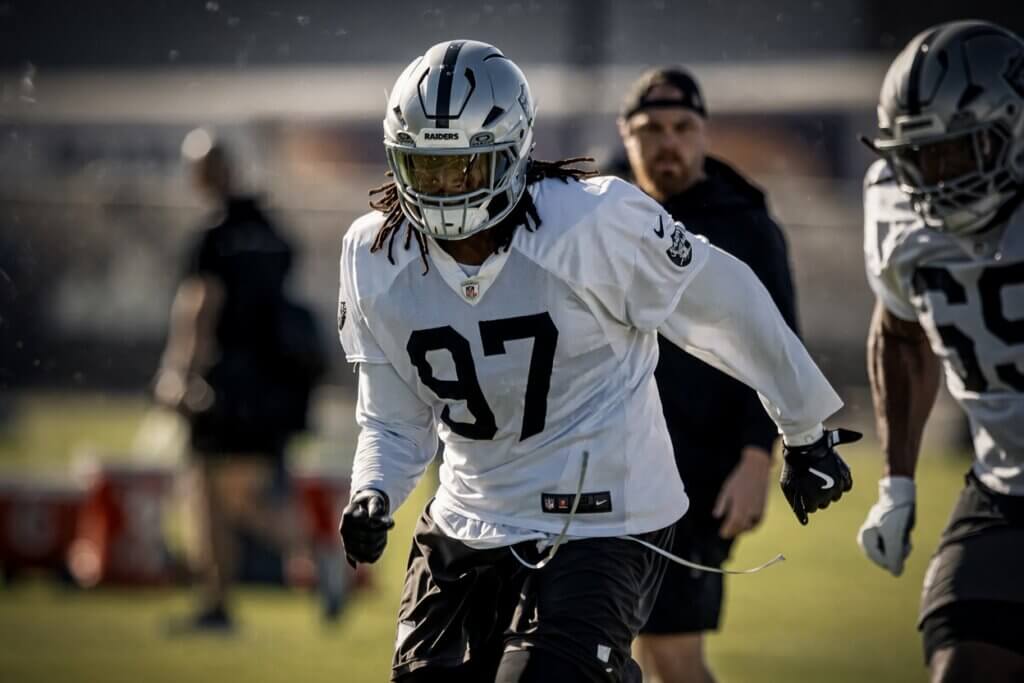
Las Vegas Raiders defensive line coach Travis Smith breaks down Tonka Hemingway’s quiet dominance, rookie growing pains, and why the room’s culture starts with listening.
Smith met with reporters Monday, and one theme kept surfacing: this group wins with its ears before its hands. Here are five takeaways.
No. 1: Tonka Hemingway says little. His film says everything.
Smith called Hemingway “one of the best listeners I’ve ever seen,” noting that whatever gets said in meetings, regardless of position group, shows up in his play. It’s a quiet trait, but coaches tend to trust it more than talk.
No. 2: Thomas Booker IV is the definition of versatile.
Booker has been shuffled across multiple spots, some familiar, some new. Smith said he competes “his tail off” no matter the rotation, which matters plenty on a line still sorting out its identity.
No. 3: The rookies are in a “race to maturity.”
lone and Keyron Crawford as first-year players doing the unglamorous work: staying after meetings, taking notes, translating it to the field. None of them are polished. Smith was clear on that. But the habits are there.
Related: Kirk Cousins took back the first team reins on Monday
No. 4: Cian Slone is proof that size is not the whole scouting report.
Slone doesn’t look the part of a prototypical edge rusher, and Smith said as much. But he called Slone’s disposition “relentless” and his physicality a constant, arguing intelligence and effort are doing real work here regardless of frame.
No. 5: Raiders veterans are coaching almost as much as coaches are.
Smith singled out Adam Butler, alongside Maxx Crosby, for stepping into teaching moments unprompted, pulling rookies aside mid-practice to correct or encourage. Smith framed it as the backbone of a “player-led” culture, the kind that outlasts any single coaching staff. Crawford, for his part, has responded to that environment by leaning in further. He’ll send Smith film breakdowns and questions well after practice ends.
None of this shows up on a stat sheet Thursday night. Sacks, pressures and stops will tell their own story, and culture rarely gets a line in a box score. But Smith’s answers paint a room less concerned with individual reps than with information transfer, from coach to veteran, veteran to rookie, meeting room to grass. It’s a philosophy built less around any single standout performance and more around repetition, communication and trust compounding over time.
Whether that translates to production remains the actual question, and it’s not one training camp practice reports can answer. Preseason snaps will offer the first real look. Still, the true test comes once the games start counting and the rotations Smith described get put in front of opposing offenses.
For now, at least, the Raiders’ defensive front sounds like a group that is listening awfully closely. They’re also betting that the habits being built in meeting rooms this August will show up on Sundays this fall.
*Top Photo: Ramble Illustration/Getty Images