
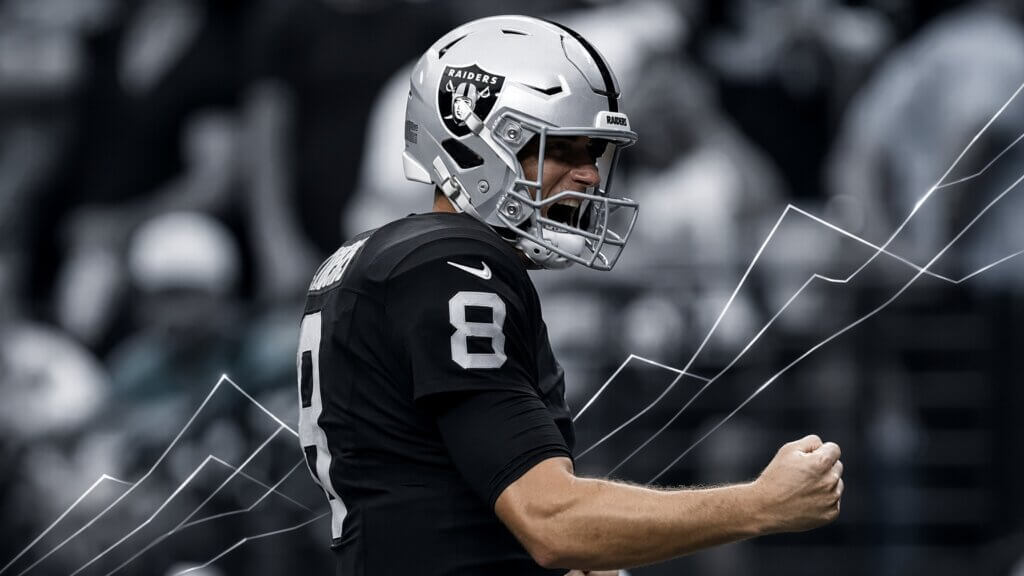
Three games have changed the conversation around Las Vegas. The Raiders opened 2026 at 3-0, turning an encouraging September into one of the AFC’s most notable early developments.
The turnaround extends beyond the standings. Several players have given Las Vegas a clearer identity on both sides of the ball, and expectations have shifted accordingly.
The sample remains small, but the Raiders’ unbeaten opening three games created reasons to examine what has driven their improved start.
Market Movement Signals a Raiders Revival
Preseason expectations left Las Vegas well outside the shortest-priced contenders. The Las Vegas Raiders odds opened around +4000 to win the AFC West, +12000 for the AFC, and +20000 for Super Bowl LXI.
Those numbers have compressed considerably, with Las Vegas now 3-1. Las Vegas has shortened to approximately +750 in the division, +3300 in the conference and +7000 for the Super Bowl.
The movement follows one consistent direction. Rather than reflecting one isolated matchup, all three markets have shifted as the Raiders have accumulated victories and provided new evidence about their potential across September.
Three games can’t settle questions that require an entire season to answer. They can, however, change expectations. Las Vegas has moved closer to established contenders, raising the question of which players have driven that change. The answer begins with a veteran quarterback providing stability.
Related: The Raiders Aren’t Rebuilding Anymore, They’re Becoming a Problem
Cousins Provides a Steady Veteran Hand
Kirk Cousins arrived in Las Vegas with more than a decade of NFL experience. That background matters for a Raiders offense seeking consistency at a position that has experienced considerable turnover in recent seasons.
Through the Raiders’ 3-0 opening stretch, Cousins provided that steadier presence. His role isn’t simply to produce occasional explosive plays. Managing protections, distributing the football and keeping possessions functioning have become equally important parts of the equation.
That experience also helps when games change direction. Las Vegas has already faced different situations in victories over Miami, the Chargers, and New Orleans. Having a veteran quarterback provides an established reference point when defensive looks or game scripts change.
Cousins therefore supplies the foundation rather than carrying the entire turnaround himself. His presence gives the Raiders greater structure through the air, but balance remains essential. That is where Ashton Jeanty’s workload begins shaping the offense around him.
Jeanty Builds the Backfield’s Early Identity
Ashton Jeanty gives Las Vegas another way to control possessions. His workload best shows his importance, with the Raiders consistently giving their featured back opportunities to establish the rushing attack.
Volume matters because rushing production influences what comes next. Productive early-down carries can create shorter third downs, open play-action opportunities and prevent defenses from treating every important snap as an obvious passing situation.
That balance complements Cousins. NFL statistics show that the quarterback doesn’t need to manufacture every productive possession when Las Vegas can maintain another route forward on the ground. Jeanty’s involvement therefore becomes part of the offense’s structure rather than an isolated statistical storyline.
His presence also gives opposing defenses another decision to make before the snap. When defenses devote more attention to the backfield, they can leave more space elsewhere. That becomes especially significant when Brock Bowers moves through formations and hunts for favorable matchups.
Bowers Turns Mismatches Into Weekly Advantages
Defensive coordinators can’t treat Brock Bowers like a conventional tight end. His receiving ability allows Las Vegas to move him around the formation and create different matchups, forcing opponents to decide which defender and coverage structure can handle him.
That versatility can create difficult personnel decisions for defenses. A linebacker may struggle with Bowers’ movement, while using a defensive back can make it harder to defend heavier formations or the Raiders’ running game.
His Week 3 performance demonstrated the challenge. Bowers caught 10 passes for 116 yards against New Orleans, including a four-yard touchdown during the fourth quarter. His production helped Las Vegas sustain another balanced offensive performance.
Bowers consequently connects several pieces of the Raiders’ attack. Jeanty’s rushing presence draws defenders near the line, while Cousins has an established target who can attack different areas. Las Vegas has similar interconnected pieces defensively, beginning with Maxx Crosby.
Crosby Anchors a Defense Built to Disrupt
Maxx Crosby remains the player opposing offenses must account for before nearly every snap. His ability to generate pressure from the edge can alter protection plans before he records a sack or tackle.
That attention creates opportunities around him. Offensive lines can slide protection toward Crosby, add blockers, or ask quarterbacks to release the ball faster. Each response potentially changes the assignment for another Raiders defender.
The effect extends beyond individual pressure statistics. Disruption can force offenses away from their preferred timing, create difficult down-and-distance situations and reduce the opportunity for longer-developing concepts. Crosby provides Las Vegas with a consistent starting point for creating those problems.
Yet pressure works best when the defenders behind the front understand where the football is likely to go next. The Raiders need discipline and communication at the second level to complement Crosby’s aggression. Nakobe Dean provides an important part of that structure.
Dean Directs Traffic From the Second Level
Nakobe Dean occupies a different role within the same defensive equation. Where Crosby disrupts the front, Dean operates from the second level, tracking developing plays and helping connect the defensive line with coverage behind him.
Tackle production provides one measure of that involvement. Linebackers must diagnose runs, close underneath passing lanes, and respond when offenses try to exploit space created by aggressive pressure packages.
Communication is equally important. Pre-snap adjustments can determine how effectively defenders react to motion, formation changes and protection shifts. A centrally positioned linebacker has a valuable perspective for helping the defense maintain its structure.
Dean adds a different layer to the defense. Crosby can force an offense to adjust, while Dean helps the Raiders respond to what follows. Combined with the developing offensive identity, that defensive structure helps explain why Las Vegas looks considerably different from the team preseason expectations anticipated.
A Turnaround With Multiple Drivers
The Raiders’ opening month has changed expectations because the improvement has come from several directions. Cousins supplies experience, Jeanty establishes a rushing foundation and Bowers creates matchup problems that expand the offense.
Defensively, Crosby remains the disruptive centerpiece while Dean helps connect the levels behind him. The resulting 3-0 start has driven substantial movement around Las Vegas, but September is only the beginning. Maintaining that trajectory will require these individual strengths to continue working together as the schedule provides increasingly demanding tests.
*Top Photo: Ramble Illustration/Getty Images