
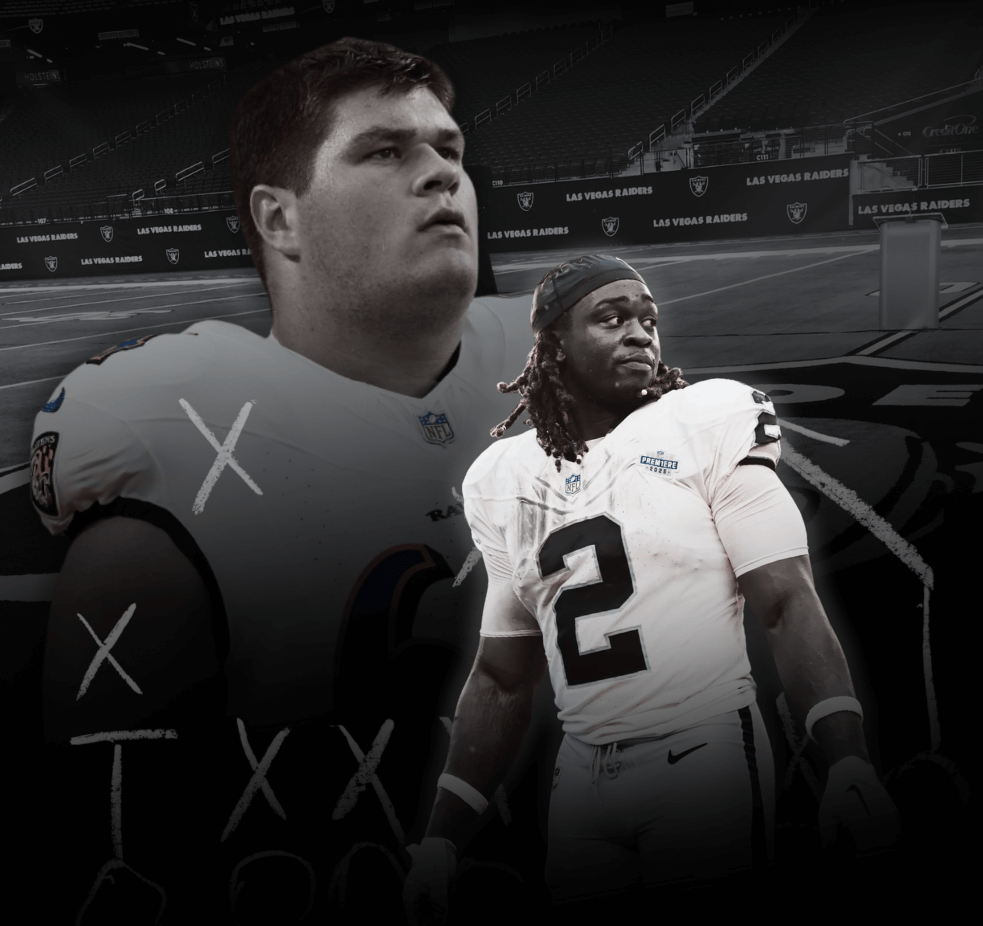
The Las Vegas Raiders’ ground game has gone from a Week 1 strength to a glaring weakness. Now, Klint Kubiak’s wide zone scheme is facing a harsh reality check.
The Silver and Black did not forget how to run the football. They just ran into the part of the season where the scheme they chose starts asking for more than raw effort.
In Week 1 against Miami, Ashton Jeanty ran 23 times for 102 yards, and Mike Washington added 41 more. The line moved people, and the holes were there. Since then, the ground game has gone quiet. Against the Chargers, it disappeared, and then against the Chiefs, it managed 72 yards. Afterward, against the Patriots, it averaged barely more than 2 yards a carry. Against the Bills, it finished with 65 yards. The Raiders now sit near the bottom of the league in yards per carry.
Coach Klint Kubiak has said for weeks that the problem falls on him and the staff, and he is not wrong. The wider truth is that the wide zone offense he brought from Seattle is not a plug-and-play system. It is a language, and languages take time to speak fluently.
What wide zone actually asks for…
Wide zone, or outside zone, is the backbone of the Shanahan-tree offense Kubiak runs. It does not ask five linemen to drive five defenders straight backward. It asks them to step laterally, in the same direction, and create a horizontal stretch across the formation. The goal is to force the defense to move sideways. When the defense stretches, creases appear, and the running back reads the first unblocked defender and either keeps the play outside or cuts back inside.
That sounds simple until you watch it at full speed. The left tackle has to reach a defensive end who is often bigger and more explosive than he is. The guards and center have to combo-block on the move, and then one of them has to climb to a linebacker who is flowing with the play. If anyone is late, the back has nowhere to go. If anyone overruns his landmark, the cutback lane closes. The whole line is moving together, and the defense is trying to beat it to the spot.
That is why the scheme takes a special kind of lineman. Strength still matters, since a center who cannot handle a nose tackle on a double-team will get driven into the backfield. But athleticism and timing matter just as much. The best wide-zone linemen are quick enough to get their hats on a defender who is trying to cross their faces, smart enough to know when to stay on the combo and when to release, and coordinated enough to do it without the man next to them losing his assignment. It is less about winning a one-on-one power contest and more about winning a race to a spot while four other people are doing the same thing.
Seattle’s line under Kubiak last season was not elite in Week 1 either, but the run game improved as the year went on because the players got more reps together. The Raiders are in that same early stage, with one key difference. Last year’s Raiders line was already one of the worst in football, and the group did not arrive with years of zone experience. It arrived with a new coach, a new language and a roster that is still sorting itself out.
The pieces they have right now…
Kolton Miller is the most natural fit at left tackle. He has the length and lateral movement to reach defensive ends and still get back to his landmarks. Center Tyler Linderbaum is another. He is athletic enough to work combo blocks on the move and climb to the second level. Those two can play this scheme, but the rest of the line is still figuring out how much of it fits them.
Left guard Spencer Burford came from the 49ers, so he has played in a related system, but that experience has not translated yet. He has struggled in both protection and the run game. Caleb Rogers has gotten more work at right guard and brings the kind of athleticism the scheme wants. Jackson Powers-Johnson, who is probably better suited to a gap scheme, has the power, but the mental side of zone blocking, knowing when to stay attached and when to climb, has been an issue. Right tackle DJ Glaze has been better than many expected. He is not the most explosive athlete, but he has held up. Depth is thin, and when one of the starters struggles, the next man up has not consistently changed the picture.
Coach Klint Kubiak has already said he is looking at everything, and that is the right answer. Zone schemes can hide one limited player, but they cannot hide two or three. The Raiders have athletes in the right places. They do not yet have five linemen who trust the same landmarks on every snap.
It is not only the line..
The linemen do the lion’s share of the work, but the scheme falls apart if the other 10 players are not doing their jobs.
The running back has to be decisive. Wide zone is not meant for backs who like to dance in the backfield. The back takes the handoff, reads the first defender he sees and either presses the edge or cuts it back. Hesitation turns a crease into a tackle in the backfield. Jeanty has the vision and the contact balance, but film of the last several weeks shows him thinking too long at times. Washington has looked more decisive on the carries he has gotten. Both can play in this system, and both still have to trust that the stretch will create the cutback and then hit it without a second thought.
The tight ends matter more in this offense than people realize. Brock Bowers, Michael Mayer and Ian Thomas are asked to seal edges, climb to linebackers and still be threats in the passing game. When Bowers lines up as an inline tight end and wins his block, the play can bounce outside. When he releases into a route, the defense has to account for him and the stretch at the same time. The Raiders have used multiple tight ends and fullbacks to create extra blockers, but that only works if those players win their one-on-ones at the point of attack. Bowers has been the offense’s most reliable player, yet the run game still needs him and Mayer to be consistent blockers on the edge, not just receivers.
The wide receivers have a job, too. On the perimeter, they are asked to stalk-block cornerbacks or crack down on safeties. If the outside receiver loses his block, the play dies even if the line does its job. The receivers also create the horizontal stretch just by aligning outside, and when they motion or shift, they force the defense to show its hand. That is free information for the line and the back. The Raiders’ receiver room is thin, so the healthy ones still have to win those perimeter blocks or the stretch never fully develops.
The quarterback’s role is quieter but just as important. Cousins has to sell the play-action and the bootleg, and wide zone sets up those throws because the defense is moving laterally. If the quarterback does not sell the run, the linebackers stay home and the windows close. Cousins has done this well enough that the passing game has carried the offense while the run has lagged. The problem is that defenses have started to ignore the run threat, and when they do, the play-action loses its power. The quarterback cannot fix a line that is not stretching the defense. He can only take advantage of it when the stretch is real.
Related: 3 Keys to the Raiders ending their losing streak vs. the Rams
What better looks like…
The Raiders do not need a new scheme. They need more consistent execution of the one they have. That starts with the line getting to its landmarks on time and staying patient on the combo blocks. It continues with the backs hitting the hole instead of waiting for a bigger one. It includes the tight ends and receivers winning their perimeter blocks so the stretch actually stretches. And it requires the coaching staff to keep calling the run even when the early results are ugly, the way Seattle eventually did last season.
Kubiak has already taken the blame, and he has also said he will look at personnel. Both things can be true. The pieces are not a perfect fit, but they are not a bad one either. Miller and Linderbaum can play this way, and Glaze has shown enough. Burford, Rogers and Powers-Johnson need to be better, or the rotation needs to change. The skill players around them are talented enough to make the scheme work once the line creates the horizontal movement the play is built on.
Week 1 showed what the run game can look like when the pieces are in sync, and the weeks since have shown how hard it is to stay that way. Wide zone is not magic. It is a system that rewards athletes who move together and backs who trust what they see. The Raiders have the athletes, but they are still learning how to move together. Until that changes, the passing game will keep carrying the load, and every defense will keep daring them to run.
The scheme can work here. When the Raiders figure it out, Jeanty and Washington will be a duo that produces week in and week out, and the passing game will open up as well. So much will happen once it all comes together, but it has not fully arrived yet.
*Top Photo: Ramble Illustration/Getty Images