
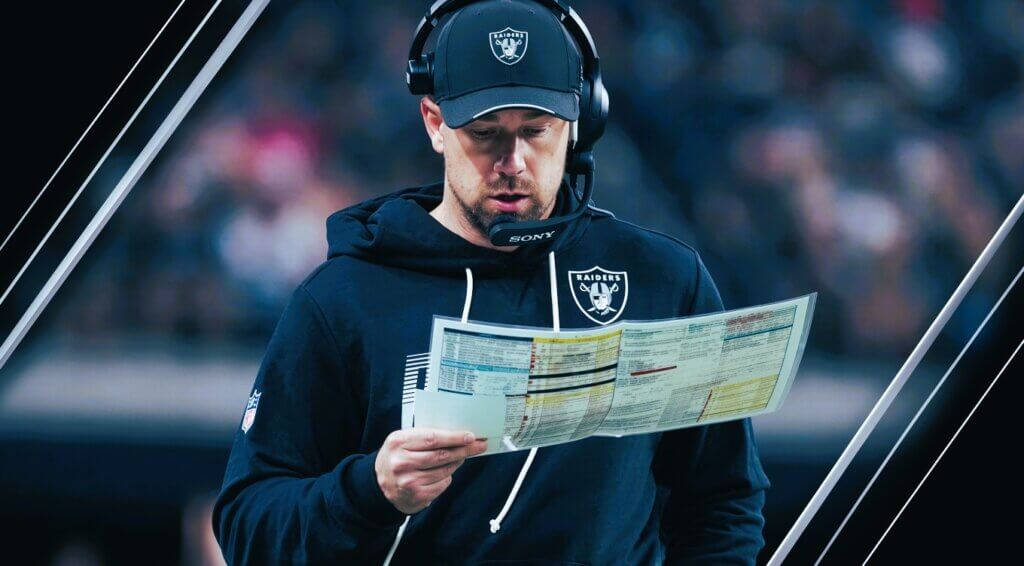
Mark Davis has spent more than a decade changing coaches without changing the Las Vegas Raiders‘ fortunes. Klint Kubiak may finally have something his predecessors lacked: control over the people and decisions that will define his tenure.
Davis has hired and fired more head coaches than any other owner in the NFL since he took control of the Raiders in November 2011. That is not a distinction a franchise seeks. But the pattern invites a question the record alone cannot answer: Did the Raiders keep choosing the wrong coaches, or did they keep building the wrong conditions around them?
Kubiak, in his first season, is the latest test. The early evidence suggests Las Vegas may have changed the conditions this time. It also suggests the franchise has made itself easier to judge.
A decade of big swings…
Davis deserves credit for ambition. He has not filled the job with placeholders. Jon Gruden’s departure was unlike anything the league has seen, and many fans believe he had the team on the right track before his coaching career ended. Josh McDaniels and Pete Carroll were prominent hires. Neither worked.
The failures differed in kind. Fans never embraced McDaniels, and his goodwill with the public ran out faster than that of any recent head coach. It may have run short in the locker room, too. Antonio Pierce, by the prevailing view, probably was not ready for what the job demanded, and he inherited a team without a quarterback.
Carroll’s case was the most instructive. He arrived with one of the strongest résumés of the past two decades, yet the consensus is that he was caught in a constant power struggle with general manager John Spytek and minority owner Tom Brady. He reportedly could not even hire the coordinators he wanted.
That detail matters more than the won-lost record. A coach who cannot choose his lieutenants cannot be held fully responsible for the results. Neither can the people who hired him. When authority is divided, accountability disappears with it.
The case for belonging…
Kubiak’s circumstances look different, and the contrast came from an unexpected source. Radio host JT the Brick, who hosts a Raiders-focused show, asked the first-year coach what he was thankful for.
Klint Kubiak said he was thankful to be a Raider.
The answer landed with the host because of Kubiak’s history. Kubiak grew up around the Denver Broncos. His father won a Super Bowl with the team, and the family’s ties ran through John Elway and Mike Shanahan. Taking the Las Vegas job meant, in the host’s words, going against the family in Denver.
The host drew a line between Kubiak and his predecessors. Pierce was a New York Giant. McDaniels was a Patriot “through and through.” Carroll was a Seahawk and, even more, a Trojan. Each tried to wear the silver and black, the host argued, but each remained something else. Of Kubiak, he said, “He is locked in.”
That is one man’s read on another man’s sincerity, and it should be treated as such. Thankfulness is cheap to express and impossible to audit. But the claim has a logical edge. A coach who gave up a lifelong identity to take this job has less to fall back on. His reputation is tied to Las Vegas in a way a transplanted star’s might not be.
Structure may matter more than sentiment…
The sturdier evidence is organizational. Based on available reporting, Klint Kubiak assembled the staff he wanted. That includes defensive coordinator Rob Leonard, who was reportedly his first choice for the job. Carroll, by comparison, had no prior history with Leonard before he joined the Raiders.
This is the quiet difference between Carroll’s tenure and Kubiak’s. One coach spent his energy negotiating for control. The other appears to have started with it. In a business where outcomes are noisy, the clearest sign of a healthy hire is that no one can credibly blame someone else for the results.
That cuts both ways. If Kubiak chose his people, he owns them.
The defense is the first exam…
So far, Klint Kubiak seems to have the Raiders on the right track, though patience is the open variable. Leonard’s unit must perform well this season, preferably sooner rather than later. How long Kubiak will tolerate a defense that does not is the unanswered question.
It is a fair one. A coach who picked his coordinator cannot distance himself from the coordinator’s results. The structure that protects Kubiak from the Carroll problem also removes his alibi. Either Leonard’s defense improves, or Kubiak will have to decide whether loyalty to his own choice outweighs the need for change. Davis’s history suggests the owner will not wait as long as the coach might want.
The quarterback gamble…
The second test is the one fans can watch every Sunday. Fernando Mendoza, the rookie quarterback, became the starter after the Raiders traded Kirk Cousins hours before the trade deadline. Many expected a softer landing for the rookie. The schedule delivered the opposite: back-to-back starts against two of the league’s toughest defenses, Seattle and Denver.
The results were mixed in a promising way. Mendoza played well in the first half against the Seahawks. Against the Broncos, on the road, he threw three touchdown passes. His 88.5 quarterback rating was the fifth-highest any passer has posted against Denver’s defense this season.
Broncos insider Cecil Lammey said the Raiders are “going to be a problem” with Mendoza at quarterback. The more telling testimony came from NFL Network’s Ian Rapoport, who said the optimism inside the organization is “palpable.”
Rapoport did not oversell it. He acknowledged that Mendoza has thrown to the other team with a game on the line, takes too many free hitters and absorbs too many sacks. The decisive question, he said, is whether a team believes it has a starting quarterback. Of the Raiders, he said, “They believe they have a guy.”
Related: What is Klint Kubiak’s plan for Sunday night vs. the Browns?
The concern that could undo it…
Former Raiders tackle Lincoln Kennedy is less sanguine about one specific trait. He said Mendoza’s pocket awareness worries him most. Against Seattle, Kennedy said, the rookie was at times oblivious to an incoming blitzer. He said the six sacks left him cringing and warned that no quarterback lasts in the NFL by absorbing that kind of punishment from linebackers and safeties.
Rapoport and Kennedy are describing the same flaw from different angles. The team wants Mendoza to take fewer hits. The risk is that talent and toughness can mask a habit until the habit becomes an injury.
What the two tests share…
The defense and the quarterback look like separate stories. They are really one story about accountability.
Klint Kubiak selected his defensive coordinator. The front office, by trading Cousins, committed to a rookie quarterback on the busiest part of the schedule. Neither decision can be blamed on a rival power center or an inherited roster. If both work, the Raiders will have shown that their long run of coaching turnover was a structural problem and not a talent problem. If either fails, no one will be able to point elsewhere.
That is the hidden significance of a coach who, by every report, has the authority he wanted. Davis has taken big swings before. This time, the swing came with clearer lines of responsibility, which means the result will be easier to read.
Whether Kubiak’s sincerity, his staff and his quarterback add up to a turnaround, no one can yet say. But for the first time in a while, the Raiders have set up a test they cannot easily explain away.
*Top Photo: Ramble Illustration/Getty Images