
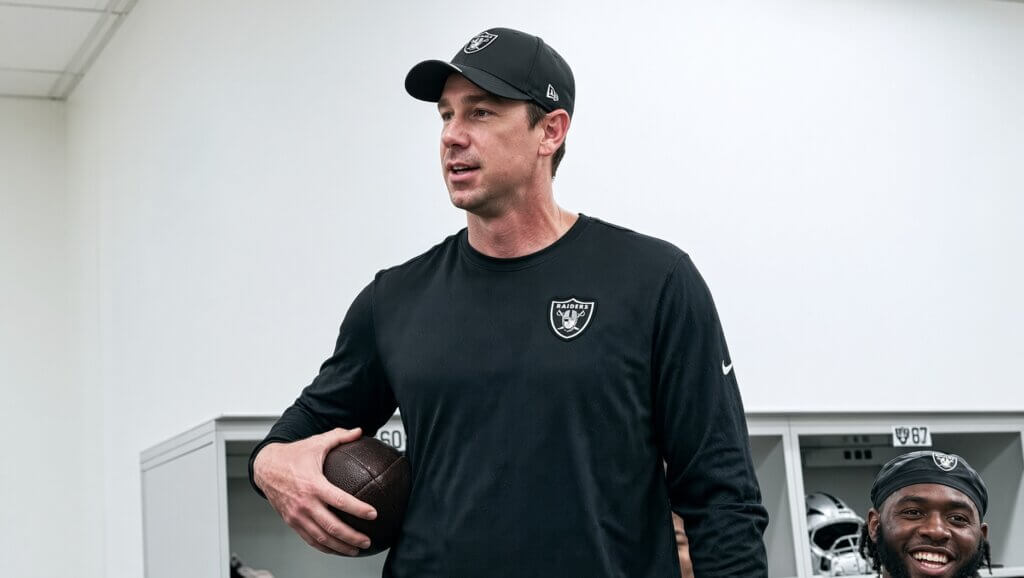
Klint Kubiak’s latest comments reveal the Las Vegas Raiders‘ game plan, mounting injury concerns and a potentially pivotal decision involving Brock Bowers ahead of Sunday night.
Kubiak’s Friday news conference was short on disclosure and long on signal. He read an injury list, answered roughly two dozen questions and gave little away about the player who dominated them. But his answers fit together into a recognizable argument: The Raiders intend to survive Sunday night’s game through structure, not personnel.
The ledger of certainty…
Start with what Kubiak made definite. Defensive tackles Adam Butler, Tonka Hemingway and Tim Keenan III are out. So is Jackson Powers-Johnson, the interior offensive lineman who, Kubiak said, was injured at practice Friday. Asked whether the injury is serious, Kubiak said, “Could be, yes,” and promised more information after the team examined him.
That is a coach saying more than he usually does. Declining to minimize an injury is a choice, and it suggests the staff is already planning without Powers-Johnson beyond Sunday.
The pattern deserves attention: Three of the four players ruled out are interior linemen on defense, and the fourth is an interior lineman on offense. Players listed as questionable are JJ Pegues, Darrell Luter Jr. and tight end Brock Bowers. Pegues is also an interior defensive lineman. The Raiders are not thin at one position. They are thin where games between the tackles are decided.
The managed ambiguity…
Contrast that with Bowers, about whom Kubiak was asked six ways and answered in nearly the same register each time. Bowers did not practice Friday after practicing the previous two days. The reason was “we still got 48 hours.” Whether he will warm up Sunday: “We’ll see.” How he has tracked: “We’re doing everything we can to get him ready.”
Read closely, the answers are consistent, not evasive. Kubiak never characterized the injury, never signaled optimism and never signaled concern. When asked whether the ankle tape was precautionary, he called Bowers “a moving target,” saying the player is working through what makes him feel best “with or without the tape.” That phrasing suggests a day-to-day, feel-based process, not a structural problem with a fixed timeline.
Two answers matter more than the rest. Asked whether Bowers needs a full week of practice to play, as was the case the previous week, Kubiak said, “Correct,” meaning no. And on the bye week, he said it “could” factor into the decision, but “if our guys are ready to go to help us win, then we want everyone to play.”
Those statements can be read two ways, and the tension between them is the story. A bye week the following week lowers the cost of playing a hurt star, because a setback can be absorbed by two weeks of rest. It also lowers the cost of holding him out, because the Raiders would have the extra time to recover him fully. Kubiak declined to say which logic governs. The most defensible reading is that Bowers’s availability is being decided by Bowers’s own function on the ankle, not by the calendar, and that the calendar is a tiebreaker.
What the weather does to the math…
Kubiak was asked about the inclement conditions that affected Thursday’s Buffalo-Kansas City game and whether wind, rain and a grass surface that could turn to mud change his approach. His answer was notably procedural: He did not see the whole game, the elements play out “in real time,” the team has “done things this week to prepare,” and it is “a feel for the game as it goes.”
The honest translation is that there is no pregame script for mud. That has consequences for the personnel picture above. Wet grass compresses the field, slows edge rushers and makes interior power more valuable on both sides of the ball. It is exactly the environment in which the Raiders’ losses on the interior line are most costly.
Yet the same conditions diminish the value of a questionable tight end. Bowers is at his best creating space after the catch and winning in the open field. A slick surface and gusting wind narrow the passing game’s margin for error, which is part of why Kubiak could say, without apparent anxiety, that Bowers does not need a full practice week.
The coach’s one concrete weather adjustment came in answer to a question about the running game. Of rookie Mike Washington Jr.’s possible increased role between the tackles, Kubiak said, “It could.” He added that the team is counting on Washington and Ashton Jeanty “to take a big load either way.”
“Either way” is the operative phrase. The load is not contingent on Bowers, or on the weather, or on how many defensive tackles are healthy. It is the plan.
Related: Latest AFC West power rankings show Raiders slipping
The guitar fake and the logic of deception…
The most revealing exchange was also the lightest. Asked about the “Guitar Fake” executed by quarterback Fernando Mendoza, Kubiak said the name was “not from me” and that the idea is simple: “In the run and play-action game, you’re trying to make schemes look similar.” Asked whether other named fakes exist, he said, “None with a name like that that I can think of right now.”
Consider what that means in context. A team expecting to run heavily in poor weather, with a quarterback leading the offense, is investing in a play that makes the run and the pass look identical. Play-action is more valuable when the defense must respect the run, and the defense must respect the run when the weather says it will be used. Deception is not a luxury here. It is the offense’s way of converting a weather-driven run-first approach into big plays that wet conditions otherwise suppress.
Mendoza himself got a measured endorsement. Kubiak said naming him a captain was “my decision” and that “he’s quarterback of the team. He’s captain.” Of his leadership, he said Mendoza has been “the same guy” and leads “by your production first.” That is a statement about expectations. It tells the room, and the observers, that the quarterback’s standing will be earned on the field.
Where the plan is exposed…
Two answers carry the unaddressed risk. First, Kubiak acknowledged that last week’s punt protection broke down, saying Denver “made some plays” and that Las Vegas must do “a better job firming up our protection.” In weather, special teams errors are amplified, since a blocked or mishandled kick in the mud can flip field position and a game.
Second, Kubiak said the Raiders are “very aware” of how clutch their opponent has been in the fourth quarter. He did not name a counter. Against a team that wins late, a depleted interior defensive line is a liability precisely when fatigue sets in. He expressed “a lot of confidence” in the replacements and called the situation “a great stage for them.” That is the language of a coach choosing optimism by necessity. Veteran Folorunso Fatukasi, whom he called a “hardworking veteran,” is being asked to anchor a line that no longer has its depth.
The thought-provoking question…
The Raiders’ success Sunday may depend less on whether Brock Bowers plays than on whether Kubiak’s plan can withstand everything working against it. By emphasizing structure over personnel, Kubiak has made a promise the weather, the injuries and the fourth quarter will put to the test.
*Top Photo: Ramble Illustration/Getty Images