
The scoreboard in Denver said 38-24, and the standings now say 4-7. Neither number captures what the Las Vegas Raiders showed in their fourth straight loss.
Rookie quarterback Fernando Mendoza threw three touchdown passes and led three consecutive scoring drives to erase a 17-0 deficit. Running back Ashton Jeanty had his best game of the season. Then a pick-six with two minutes left ended it. The question is whether that sequence points to a team close to turning a corner or one that keeps finding new ways to lose.
Start with the comeback, because it deserves credit. Denver built a 17-0 lead with a 2-yard punt, a 1-yard touchdown pass from Bo Nix to Adam Trautman and the first of three Jonah Coleman touchdowns. Las Vegas trailed 17-10 at halftime after a touchdown was wiped out by offensive pass interference. The Raiders then stopped Denver on fourth down to open the third quarter and tied the game at 17 on a well-designed touchdown pass to tight end Ian Thomas.
Ashton Jeanty was the story of the offense…
He finished with 169 yards from scrimmage, including 79 yards on 11 carries, with a 46-yard run that was his longest of the season. He also caught five passes for 90 yards, including the 68-yard wheel route for Mendoza’s first NFL touchdown pass. The Raiders had hoped for a run-game breakthrough against a Denver defense that entered the day allowing the ninth-most rushing yards per game. They got one, even if it came through a mix of rushing and receiving.
Mendoza, in his second start, finished 18-of-37 for 267 yards, three touchdowns and one interception. He did that without tight end Brock Bowers, his most dangerous target, while absorbing five sacks, 11 hits and five batted passes, three of them by Zach Allen. Jack Bech added eight catches for 88 yards and a touchdown that cut the deficit to 31-24. For a rookie playing behind a line that struggled, those are encouraging numbers. Several of his throws were described as impressive, and the offense kept finding ways to score.
The encouraging version of this story has to reckon with what happened after the game was tied. Denver answered with a 10-play, 72-yard touchdown drive, Coleman’s second score. Then came the sequence that arguably decided the afternoon. Mendoza’s fourth-and-2 pass fell incomplete in Denver territory, and Coleman ran in his third touchdown to give the Broncos a two-score cushion. Coleman finished with 111 yards on 24 carries, plus four catches for 18 yards.
This is where it gets ugly…
That is the part of the game that should concern Las Vegas most. The offense could generate points, but the defense could not get off the field. Denver’s 38 points came despite a game in which Nix threw for 225 yards, with one touchdown and an interception on an end-of-half heave. The Broncos did not need him to be great because Coleman was relentless. The Raiders entered the week ranked 31st in rushing yards allowed per game, and Denver exploited that weakness as expected. Credit Denver’s design, but this was also a predictable outcome that Las Vegas failed to prevent.
Then there is the final sequence. Mendoza had one last chance after the defense forced a stop and cut the lead to 31-24. Ja’Quan McMillian jumped a pass intended for Tre Tucker and returned it 35 yards for the touchdown that sealed the game. Rookie quarterbacks throw interceptions, and chasing a deficit invites risk. But a pick-six in that spot turns a respectable loss into a lopsided final score, and it adds to the sense that Las Vegas is always one play short.
It is worth noting how many small moments swung this game. Las Vegas had one touchdown erased by offensive pass interference and another by a ruling that Mendoza was past the line of scrimmage when he threw. Those are not trivial. Without them, the Raiders might have led or at least stayed within reach for most of the second half.
Denver also left points on the field…
Nix’s pass to a wide-open Troy Franklin bounced off Franklin’s helmet on what should have been a 58-yard touchdown. The Broncos, by one account, “always find a way to make it interesting,” and they were fortunate to be in control for as long as they were.
So the margins cut both ways. The Raiders can say they were unlucky with the penalties and the dropped-pass reprieve that kept them in the game. Skeptics can answer that good teams do not need breaks to avoid a 17-0 hole and that penalties that erase touchdowns are themselves a form of undisciplined play. Both arguments hold some weight.
Denver improved to 8-2 and sits atop the AFC West on tiebreakers over the 8-2 Chiefs. The Raiders are 4-7 and 0-2 since Mendoza replaced Kirk Cousins. That context matters for anyone still holding on to playoff hopes. The idea earlier this month that injuries elsewhere in the AFC might open a path for Las Vegas now looks much shakier. A 4-7 team with a defense that cannot stop the run and an offense missing its best receiver is a long shot, even in a conference with some vulnerable contenders.
The schedule offers no relief for the Raiders…
The Raiders travel to Cleveland next week for a game flexed to Sunday Night Football, and the Browns are among the teams Las Vegas needed to beat to stay in the conversation. The Broncos, meanwhile, face the Steelers on the road in the Black Friday game on a short week.
Fan reaction offers a useful window into how divided the argument is. One commenter on a recap argued that the offense can put up points despite line inconsistency and a lack of weapons, that it will only improve as pieces are added, and that the offseason priority must be fixing the defense. That view treats this season as a developmental one in which Mendoza’s growth is the main goal and the results are secondary.
The counterargument is that development does not happen in a vacuum. If the defense cannot get off the field on third down, Mendoza will be asked to play from behind every week, which is the hardest way for a young quarterback to learn. Five sacks and 11 hits are not a sustainable diet either. Protecting a rookie is part of developing him, and Sunday was a reminder of how much work remains.
There is also a coaching question…
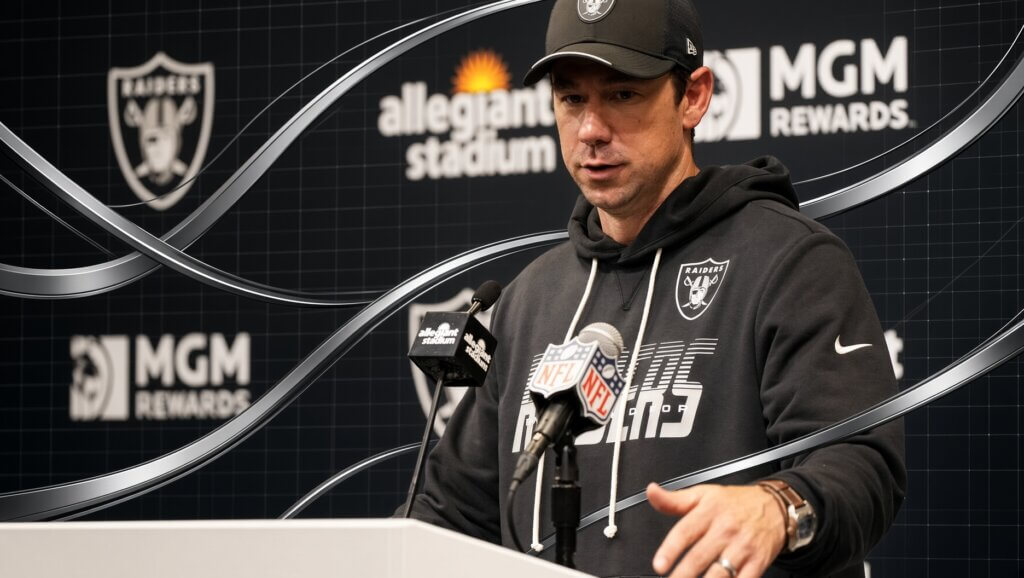
The offense scored 24 points, which is respectable, but only after trailing by 17. Why did it take so long to find a rhythm? Head coach Klint Kubiak’s play calling has been scrutinized all season, and the second-half adjustments were effective. Whether that reflects growth or merely a response to desperation is open to interpretation.
The honest reading of this game sits somewhere between the optimist and the pessimist. The optimist sees a rookie quarterback with three touchdown passes on the road, a running back finally breaking through and an offense that never quit. The pessimist sees a team that dug itself a 17-point hole, could not stop a one-dimensional rushing attack and handed the game away with a pick-six.
Related: Did Hollywood do Al Davis dirty in new “Madden” movie?
Both are right, which is what makes this loss difficult to categorize. Moral victories do not change the standings, but they can reveal whether a team is building something. The Raiders showed pieces of a competitive offense. They did not show a defense capable of supporting it.
So the questions worth debating are these. Is Mendoza’s performance enough evidence that the franchise has found its quarterback, or is it too early to say after two losses? Does Jeanty’s breakout suggest the offense should run through him, or was it a product of Denver’s defensive game plan? And with the playoffs fading, should the Raiders use the final six games to evaluate the roster or to chase wins at any cost?
*Top Photo: Ramble Illustration/Getty Images
is our offensive coordinator any good at calling plays