
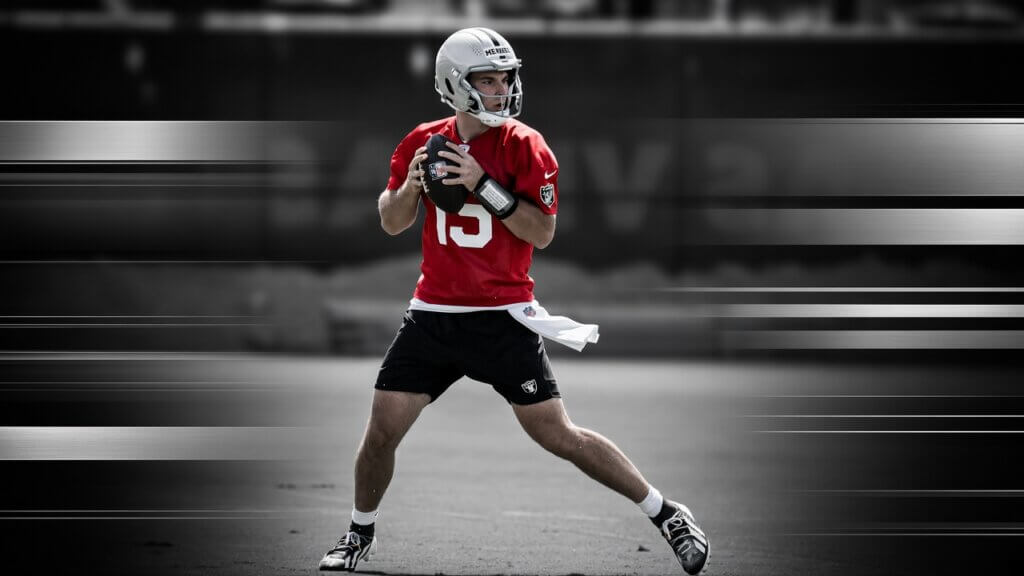
Fernando Mendoza joined Joe Burrow and Trevor Lawrence in the record books, but the Las Vegas Raiders still lost. What his second start tells us about the future.
Mendoza’s second NFL start produced the numbers that define a promising rookie quarterback, and it also produced a loss. The Las Vegas Raiders fell 38-24 to the Denver Broncos on Sunday, their fourth straight defeat, and dropped to 4-7. Yet the No. 1 overall pick threw three touchdown passes, passed for 267 yards and led three consecutive scoring drives to erase a 17-0 deficit. How much that tells us about his future is the question worth debating.
Start with the historical context. Pro Football Focus noted that only three rookie quarterbacks selected No. 1 overall have had a game with at least 250 passing yards and three touchdown passes within their first two career starts: Joe Burrow, Trevor Lawrence and Mendoza. It is a short list of players who have been franchise quarterbacks or, in Lawrence’s case, who have had to prove it. A single game does not make a career, but it does show Mendoza’s ceiling is not theoretical.
The details of the performance help the argument…
Fernando Mendoza finished 18 of 37 for 267 yards, three touchdowns and one interception, and added 22 rushing yards. His first NFL touchdown pass was a 68-yard strike to Ashton Jeanty on a wheel route, a play in which the rookie had a clean pocket and Jeanty beat linebacker Que Robinson near the sideline. The Raiders then tied the game at 17 when Mendoza hit Ian Thomas from 19 yards out, and he found Jack Bech from 7 yards out to cut the deficit to 31-24 late in the fourth quarter.
He did that without tight end Brock Bowers, the offense’s most dangerous pass-catcher, and behind a line that gave up five sacks and 11 hits. Denver also batted down five of his passes, three of them by Zach Allen. Producing in those conditions suggests a quarterback who can function when the structure around him breaks down.
The week-to-week trend is also encouraging. In his first start, a 21-13 loss to Seattle on Nov. 15, Mendoza completed 17 of 29 passes for 143 yards, was sacked six times and scored on a 10-yard run. His PFN QB Impact Score was 66.8, which ranked 23rd of 29 quarterbacks that week. Against Denver, that score rose to 70.6, good for the 16th of 22 graded performances entering Sunday night. Yards per attempt jumped from roughly 4.9 to 7.2.
Fernando Mendoza himself offered a measured read…
He believes the second start was an improvement over the first, particularly in his vision of the field and his accuracy, while acknowledging there is much left to fix before next week’s game. He also said the Raiders had miscommunication issues in Denver, adding that college is nothing like the NFL and that the crowd was very loud. That is the kind of candid, learning-oriented response coaches want from a young quarterback.
Former Raiders quarterback Derek Carr has been a consistent supporter. After the Jeanty touchdown, Carr posted, “First of many!” That echoed his message after Mendoza’s first preseason touchdown. Carr also said in July that he hoped Mendoza would get time to learn, noting that the reads and defensive recognition required in Kubiak’s offense differ sharply from what Mendoza ran at Indiana.
Optimism needs context, and the context is less flattering. Mendoza’s completion percentage actually fell from about 59% in his first start to about 49% against Denver. He also threw his first interception as a pro, and it was the costly one. With two minutes remaining and the Raiders trailing 31-24 after a defensive stop, cornerback Ja’Quan McMillian jumped a pass intended for Tre Tucker and returned it 35 yards for a touchdown. That play turned a one-score game into a two-score loss and gave the box score its lopsided look.
There were other missed opportunities…
A fourth-and-2 pass in Denver territory fell incomplete in the second half, and Denver turned that stop into a touchdown that stretched its lead to two scores. Fernando Mendoza had also thrown at least two passes that were nullified by penalty, one of them for being past the line of scrimmage. Those are the kinds of errors that decide games between teams of similar quality, and they are also the kinds of errors that tend to shrink with experience, which is the optimist’s reply.
The sack numbers need scrutiny as well. Mendoza has been sacked 11 times in two starts. Some of that falls on the offensive line, and the front office will have to address it. But quarterbacks also contribute to sacks, whether through holding the ball, misreading pressure or failing to find hot routes. A few reviews of the Week 10 game suggested Mendoza was learning to process the speed of NFL pass rushers. Whether he is the primary cause or merely a victim is a question the film will have to answer, and so far we do not have enough evidence to know.
Then there is the strength of competition. The Raiders have played two difficult defenses, and one analysis suggested those starts could pay dividends later. That is plausible. It is also plausible that facing Seattle and Denver, two of the league’s tougher defenses, inflated the apparent difficulty of the job and made Mendoza look better than average relative to expectations. A 70.6 impact score, 16th of 22, is solid for a rookie but is not evidence of a star.
Brock Bowers would’ve changed everything…
Any fair evaluation has to separate Mendoza from his environment, and the environment is a problem. Bowers has missed three games this season. The Raiders traded veteran Kirk Cousins to the Minnesota Vikings before the deadline, which thrust Mendoza into the lineup. Their offensive line has been inconsistent. A fan reacting after the game argued that the offense can score despite line problems and a lack of weapons and that the defense is the bigger offseason priority.
That argument has merit, though it is incomplete. The defense did show some improvement Sunday, holding Denver to 50 rushing yards in the first half and keeping Bo Nix to a 66.9 passer rating before halftime. But the interior defensive line was ravaged by injuries. Tonka Hemingway missed the game, and Tim Keenan and Adam Butler left during it. Denver then ran for 41 yards in the third quarter and finished with Jonah Coleman rushing for 111 yards and three touchdowns on 24 carries. A young quarterback cannot develop fully if his team is chasing points every week.
This raises the obvious tension between development and results. If the Raiders’ defense cannot hold a lead or even hold a tie, Fernando Mendoza will keep playing from behind. That limits the offense’s play-calling and exposes the rookie to more pass rush. Protecting him is part of developing him.
Context matters here, too…
The Raiders went 3-14 last season, fired coach Pete Carroll and hired Klint Kubiak. A 4-7 record with a rookie quarterback learning on the fly is not alarming by itself, and there is a respectable argument that the last two weeks show a team more competitive than its record. One observer argued the Raiders have shown they can compete with the league’s best for a full four quarters when things click. That is progress, albeit modest.
The skeptic’s response is that the Raiders have lost seven of their last eight games and now sit third in the AFC West. Competing for four quarters is a low bar. Moral victories do not alter the standings, and Las Vegas will play at Cleveland on Nov. 29 in a game that has been flexed to Sunday night. Beating the Browns would offer a stronger indicator of progress than another close loss to a contender.
There is also a legitimate question about whether Fernando Mendoza should have started sooner. Some have wondered what this season might have looked like if the rookie had been given more experience earlier. That argument cuts both ways. Starting him earlier might have accelerated his learning, or it might have exposed him to more punishment on a roster that was not ready. Carr’s early advice for patience complicates the second-guessing. Plenty of young quarterbacks have been damaged by being rushed.
The next several weeks should provide cleaner evidence than any one game. Three indicators deserve attention.
First, completion percentage and accuracy. Mendoza himself pointed to accuracy as an area of growth, and the dip from his first start to his second suggests it is still unsettled.
Second, pocket management. Sack and pressure rates will show whether he is learning to get the ball out or whether the offensive line needs help.
Third, decision-making in tight moments. The Denver interception was a reminder that late-game situations can magnify mistakes. How he handles similar spots in coming weeks will matter more than a pretty highlight on a wheel route.
Related: Did Hollywood do Al Davis dirty in new “Madden” movie?
The evidence supports a measured conclusion…
Fernando Mendoza has shown legitimate traits, including poise in the pocket on his best throws, the ability to lead scoring drives and a mature approach to his own performance. He has also shown the flaws common to rookies, including inconsistent accuracy, costly mistakes and a tendency to absorb sacks. Two starts are not enough to label him a franchise quarterback or a disappointment.
What the sample can do is sharpen the questions. If you believe in him, the logical next step is to demand the front office build a better offensive line and defense around him, since talent without support rarely thrives. If you are skeptical, you can point out that the rookie’s best numbers came in a loss and that late mistakes have defined both of his starts.
*Top Photo: Ramble Illustration/Getty Images